Scenes
Poster-first 3D and motion scene mounts with a vendored three.js runtime — the theme ships the stage, sites ship the scenes.
The scene shortcode mounts an interactive 3D or motion scene — a WebGL
canvas driven by the theme’s vendored three.js runtime — while remaining a
complete, static piece of content without JavaScript. The theme ships the
stage, not the scenes: you author a small scene module, the runtime owns
everything else (lifecycle, resizing, pausing, re-theming, failure
isolation).
Three guarantees come first:
- Poster-first. Without JavaScript, under
prefers-reduced-motion, in print, or when a scene fails, the mount shows yourposterimage with the overlay content. The scene is an enhancement of complete content, never a replacement for it. - No layout shift. The mount is sized entirely by CSS (
ratioorheight) before any script exists — scene loading cannot move the page. - Same origin, zero external requests. Scene modules and posters are site assets; URLs pointing off-origin fail the build.
# Usage
{{< scene src="js/scenes/orbit.js"
           poster="/images/scene-orbit-poster.svg"
           title="Orbit — the reference demo scene" height="24rem" pointer="on" >}}
**Real text above the scene.** The overlay is ordinary HTML — readable,
crawlable, and never rendered into the canvas.
{{< /scene >}}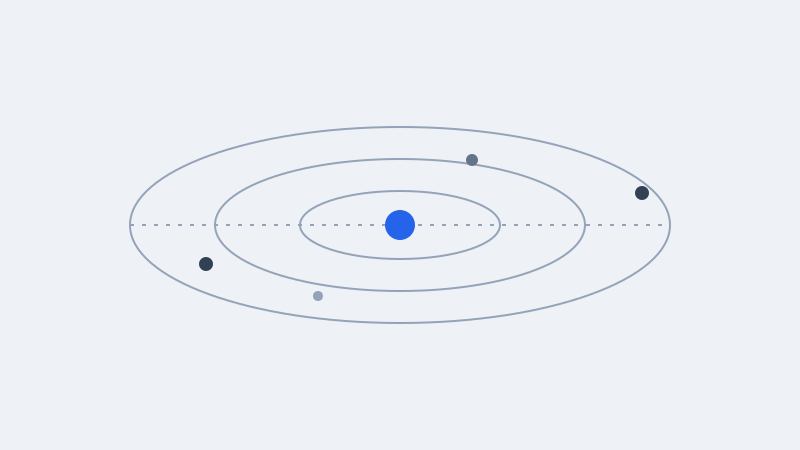
Switch presets in the sidebar to re-theme the wireframe. Scroll to tilt it,
or move your cursor over the art to lean the camera (pointer="on").
The reference uses height="24rem" so the copy panel leaves substantial art
space on narrow screens; the shortcode default remains ratio="16/9".
The copy panel has an opaque backing so arbitrary artwork cannot reduce text
contrast. Text remains selectable. If you override --docs-scene-scrim, verify
contrast for your entire artwork range in every supported preset.
# Parameters
| Param | Default | Description |
|---|---|---|
src |
— required | Site asset path of the scene ES module (below). Relative only; URL schemes and // fail the build. |
poster |
— required | Site asset path of the static frame shown without JS, under reduced motion, in print, and on scene failure. |
title |
— required | Accessible name — becomes the figure’s aria-label and the poster’s alt. |
runtime |
three |
Adapter id. v1 ships three. |
load |
visible |
Init strategy. visible: start when the mount scrolls into view. click: defer scene fetch and start until activation. A click-only page also defers the heavy runtime. Controls are hidden until bound, without JavaScript, and under reduced motion. |
pointer |
off |
on delivers normalized pointer position to the scene (fine-pointer devices only). |
assets |
— | Manifest id: data/scenes/<id>.yaml, a flat map of safe names to site asset paths. Hugo validates, fingerprints, and emits the URL map; the scene reads it through ctx.assets / ctx.fetchAsset. See Asset-backed scenes
. |
ratio |
16/9 |
Positive aspect ratio of the mount. Static text supplies an intrinsic minimum to prevent clipping. Mutually exclusive with height. |
height |
— | Positive definite CSS length instead of a ratio (for example 28rem or 60dvh); percentages and zero are rejected. Static text may require a larger intrinsic minimum. |
class |
— | Extra classes on the mount. |
Invalid parameters are build errors, not silent fallbacks.
# The scene module contract
A scene is a dependency-free ES module in your site’s assets/js/scenes/.
The runtime calls its default export once with a frozen context and expects
a small instance back. This minimal scene shows the synchronous contract;
the shipped orbit adds pointer easing:
export default function createScene(ctx) {
  const { THREE, canvas, gl, width, height, dpr, palette } = ctx;

  const renderer = new THREE.WebGLRenderer({ canvas, context: gl, antialias: true });
  renderer.setSize(width, height, false);
  renderer.setPixelRatio(dpr);

  const scene = new THREE.Scene();
  const camera = new THREE.PerspectiveCamera(45, width / height, 0.1, 100);
  camera.position.set(0, 0, 5);

  const material = new THREE.MeshBasicMaterial({
    color: new THREE.Color(palette.accent.css),
    wireframe: true,
  });
  const mesh = new THREE.Mesh(new THREE.IcosahedronGeometry(1.4, 1), material);
  scene.add(mesh);

  return {
    frame(t, dt, s) {
      mesh.rotation.y += dt * 0.5;
      mesh.rotation.x = Math.sin(t * 0.0002) * 0.25 + s.scroll.progress * Math.PI;
      renderer.render(scene, camera);
    },
    onPaletteChange(p) {
      material.color.set(p.accent.css);
    },
    onResize(w, h, dpr) {
      renderer.setSize(w, h, false);
      renderer.setPixelRatio(dpr);
      camera.aspect = w / h;
      camera.updateProjectionMatrix();
    },
    dispose() {
      mesh.geometry.dispose();
      material.dispose();
      renderer.dispose();
    },
  };
}
Contract rules:
THREEarrives viactx— do not bundle three into your scene (that would ship a second copy); the vendored runtime provides it.- Use
ctx.glas the renderer’s context (the runtime pre-creates it and uses the same context for feature detection and loss recovery). frame(t, dt, signals)is called per animation frame and must render. A throw permanently retires the scene for the page — the poster returns.paletteis a frozen snapshot of the active preset’s tokens (accent,bg,surface,surface2,text,muted,border), each withcss(string) andr/g/bsRGB floats 0–1 (nullfor unparseable formats).modeis"light"or"dark";presetis the preset id.
# Signals
| Signal | Shape | Notes |
|---|---|---|
signals.scroll |
{ progress, velocity } |
Native scroll of the mount through the viewport, 0→1. Raw values — smooth them in your scene if you want. |
signals.pointer |
{ x, y, active } |
−1..1 from the mount’s center; only armed with pointer="on" and on fine-pointer devices. Raw values — ease them in your scene, as the demo does. |
# Lifecycle
data-scene-state on the mount walks idle → loading → live, with paused
when scrolled away or the tab hides. Returning resumes actual frames and flushes
any size changes before rendering. recovering denotes the first lost GPU
context; error is terminal when anything else fails (a
throwing scene, missing WebGL2, a lost GPU context that cannot recover).
Explicit teardown sets disposed. Errors are logged with the [symblix-motion] tag and a stable reason code. A lost GPU context gets
exactly one automatic re-init; a second loss is permanent. An async scene
stays in loading (internal stage ready) until its ready promise
resolves and the first frame renders; rejection or the shared 10-second
startup deadline is terminal. The
Scene Failure Fixtures
page
demonstrates the isolation live with deliberately broken scenes.
# Degradation matrix
| Condition | Result |
|---|---|
| No JavaScript | Poster + overlay; fully readable |
prefers-reduced-motion: reduce |
Runtime never starts — poster + overlay |
| No WebGL2 | state=error, poster + overlay |
| Scene throws / fails to load | state=error, poster + overlay, other scenes unaffected |
ready rejects or exceeds the 10 s deadline |
state=error, poster + overlay, generation aborted |
| Invalid asset manifest (hand-edited) | state=error before any request for that mount |
| Canvas hidden, poster printed |
# Type hints for scene authors
THREE arrives as a function argument, so editors do not type it
automatically. Drop this scenes.d.ts next to your scenes to restore
editor hints (the shape mirrors the contract table above):
declare namespace scene {
  export interface Color { css: string; r: number | null; g: number | null; b: number | null }
  export interface Palette {
    preset: string;
    mode: "light" | "dark";
    accent: Color; bg: Color; surface: Color; surface2: Color;
    text: Color; muted: Color; border: Color;
  }
  export interface Signals {
    scroll: { progress: number; velocity: number };
    pointer: { x: number; y: number; active: boolean };
  }
  export interface Context {
    api: 1;
    THREE: object;
    gl: WebGL2RenderingContext;
    canvas: HTMLCanvasElement;
    width: number; height: number; dpr: number;
    mount: HTMLElement;
    palette: Palette;
    signal: AbortSignal;
    onDispose(cleanup: () => void): void;
    assets: Readonly<Record<string, string>>;
    fetchAsset(name: string): Promise<Response>;
  }
}
declare function createScene(ctx: scene.Context): {
  ready?: Promise<void>;
  frame(t: number, dt: number, s: scene.Signals): void;
  onResize?(w: number, h: number, dpr: number): void;
  onPaletteChange?(p: scene.Palette): void;
  dispose?(): void;
};
Context members beyond the synchronous basics:
| Member | Contract |
|---|---|
ctx.signal |
AbortSignal that fires when this scene generation retires (failure, teardown, motion revocation, context loss). Check it after every await. |
ctx.onDispose(fn) |
Registers cleanup for the current generation. Call it before an async continuation so partial construction cannot leak; the runtime runs each cleanup exactly once. |
ctx.assets |
Frozen allowlisted map of manifest name → same-origin URL. Empty without assets=. |
ctx.fetchAsset(name) |
Fetches the captured URL with the generation signal and credentials: "same-origin"; rejects for unknown names or non-OK responses. |
instance.ready |
Optional thenable gating the first frame. The poster stays until it resolves; rejection or the shared 10 s startup deadline is terminal. An async factory is invalid, not silently adopted. |
ctx.palette |
The initial snapshot only — later preset changes arrive through onPaletteChange. |
# Resource ownership
Factories are synchronous. ctx.signal aborts when a scene generation retires.
Use ctx.onDispose(cleanup) to register resources before construction can throw;
the runtime invokes each registered cleanup once, including after partial failure.
The returned instance’s dispose() is a separate once-only callback: avoid
registering the same resource disposal in both places.
frame(t, dt, signals) receives a millisecond performance timestamp and seconds
since the previous active frame. The first frame after a pause receives dt=0
and zero scroll velocity. Accumulate dt for simulations that should stop in
the background.
# Asset-backed scenes
A scene that needs data — a model, a diagram, an authored JSON layout — does
not hardcode URLs. The assets parameter selects data/scenes/<id>.yaml: a
flat map of safe names to site asset paths, validated, resolved, and
fingerprinted by Hugo at build time. The mount receives the map as a frozen
ctx.assets, and ctx.fetchAsset(name) fetches the allowlisted URL with the
generation’s AbortSignal and credentials: "same-origin". Every entry is
re-validated at consumption — the runtime does not trust the attribute just
because its own build wrote it. Names must match ^[a-z][a-z0-9_-]{0,63}$
(at most 64 entries, no nesting, no scheme, query, fragment, or .. segment).
Example data/scenes/instrument.yaml:
model: models/instrument.jsonThe instance may declare an optional ready: Promise<void>. The host keeps
the poster while readiness is pending, validates the thenable shape, then
waits for it — and only a successful first frame marks the mount live.
Module admission through readiness shares one 10,000 ms deadline; a rejection
or timeout is terminal for that host (scene-ready / scene-timeout), the
generation aborts, registered cleanups run once, and the poster stays.
Asynchronous factories are invalid, not silently adopted — createScene must
return synchronously and put its waiting in ready.
Ownership example — register disposal before each async continuation, and abort-check after it:
export default function createScene(ctx) {
  const { THREE, gl, canvas } = ctx;
  const renderer = new THREE.WebGLRenderer({ canvas, context: gl });
  const scene = new THREE.Scene();
  const camera = new THREE.PerspectiveCamera(45, 1, 0.1, 100);
  camera.position.z = 5;
  ctx.onDispose(() => renderer.dispose());

  let model = null;
  const ready = ctx.fetchAsset("model")
    .then((response) => response.json())
    .then((json) => {
      if (ctx.signal.aborted) return;
      model = new THREE.ObjectLoader().parse(json);
      ctx.onDispose(() => {
        model.traverse((n) => { n.geometry?.dispose(); n.material?.dispose(); });
      });
      scene.add(model);
      return undefined;
    });

  return {
    ready,
    frame() { renderer.render(scene, camera); },
    onResize(w, h) { renderer.setSize(w, h, false); camera.aspect = w / h; camera.updateProjectionMatrix(); },
  };
}
This mount demonstrates the full path with the shipped local model — the poster stands until the parsed instrument renders, and a withheld or failed asset leaves the poster with no dead canvas:
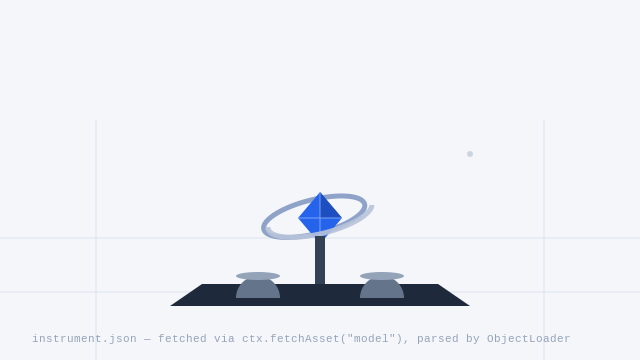
The ObjectLoader JSON here is a plain core-three format: the theme ships no
glTF/Draco/KTX2 addon support, and loading external model formats would be a
separate pinned-dependency decision. Site scenes remain responsible for any
requests their own code makes beyond the helper.
# Troubleshooting
The debug setting reserves verbose diagnostics; measured startup and CPU timing
will be delivered with the diagnostics slice of SYM-MOT-002. The
data-scene-state attribute on the mount and window.SymblixMotion.hosts
are always available for inspection.
# Budgets
Scene pages download a small same-origin bootstrap (≤ 4 KiB raw). It waits for page load, idle time, foreground visibility, motion permission, and visible or click intent before downloading the heavy runtime (three.js included, ≤ 780 KiB raw / ≤ 220 KiB gzip). Reduced motion prevents heavy runtime and scene requests. If motion is revoked after activation, scenes retire to their posters until the next navigation or reload. Scene modules are site content — keep each under ~50 KB and posters under ~200 KB. See the README for the full budget policy.